



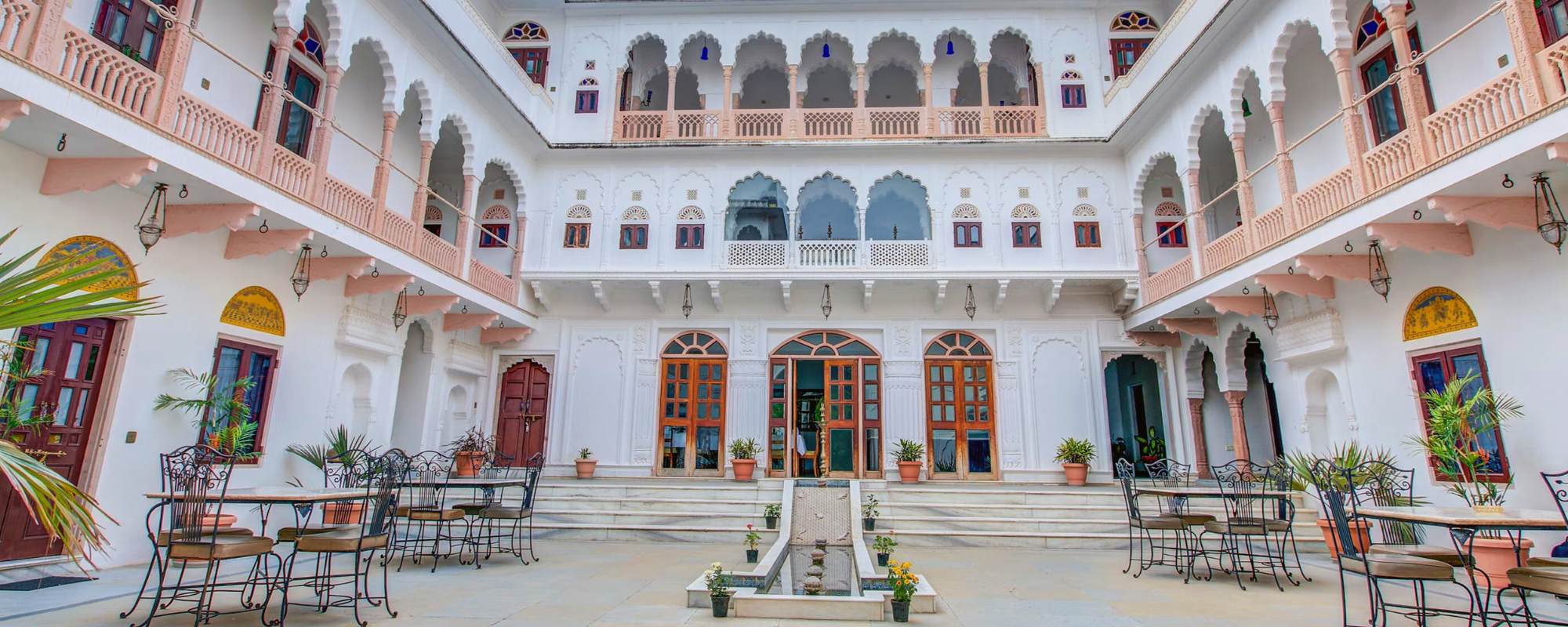



Located about 160 km from Jaipur, the small city of Karauli is an exquisite home to well-decorated Havelis, peaceful shrines, picturesque views, and intricate chhatris that dot the entire city. This beautiful place in Rajasthan shares its borders with the heart of India, Madhya Pradesh, and is surrounded by Dausa, Dholpur, and Sawai Madhopur in Rajasthan. This city resonates with Mughal architectural flamboyance and is quite famous for its pale red sandstone that surrounds the entire city with a strong and sturdy wall. Apart from its royal history, Karauli offers its visitors a rural and tranquil ambience with warm and hospitable behaviour, echoing the true old Rajasthani culture

Built in the 11th Century CE and situated on the outskirts of Karauli, at a distance of about 25 km from the city, is the temple of Kaila Devi. This beautiful shrine is right on the banks of the Kalisal River in the ranging hills of Trikut and is one of the attractions of Karauli. Covered with rich and dense forests, the Kaila Devi Sanctuary begins right after the Kaila Devi Temple and extends on both sides of the road to eventually join the Ranthambore National Park. This green reserve is home to some great wildlife species like chinkaras, nilgai, jackals, and leopards. 

Built in the nineteenth century, Shri Mahavir Ji Temple, as the name suggests, is a spectacular architectural structure dedicated to the Jain Tirthankars. It is one of the most frequently visited and famous pilgrimage destinations for the Jains. The sculpture, design, and structure of this building are highly inspired by Jain art and architecture. 


Explorations & Experiences in Karauli -

EXPLORE (Places to visit in Karauli):

  • Kaila Devi Temple
  • Kaila Devi Sanctuary
  • Karauli City Palace
  • Chattri of Raja Gopal Singh
  • Shri Mahavir Ji Temple
  • Madan Mohan Ji Temple
  • Bhanwar Vilas Palace
  • Timangarh Fort


EXPERIENCE (Things to do in Karauli):

  • Village Safari
  • Village Walk
  • Wildlife tour at Kaila Devi Sanctuary
Reach out to our Local Experts
Plan Your Bespoke Journey with Us

Fill in your details and one of our destination experts will get in touch with you. Our experts are dedicated to providing personalized assistance and insights, ensuring that all your queries are addressed and you receive the best possible guidance for your travel plans.


Checkout our
Latest Blogs
Choose from the best
Hotel Partners
Get our latest updates
Subscribe Our Newsletter

Stay Connected
FAQs
  • Why is Karauli worth visiting given how few tourists go there?

    Founded in 1348 AD by Raja Arjun Pal of the Yaduvanshi Rajput dynasty and originally called Kalyanpuri, Karauli is one of India's oldest surviving Rajput kingdoms, roughly 160 km southeast of Jaipur. It receives very few international visitors despite a remarkable concentration of havelis, temples, wildlife, and royal heritage: the City Palace's stone carving, the Kaila Devi Temple, the decorated havelis of the old walled city, and the Bhanwar Vilas Palace heritage hotel together make it one of Rajasthan's most genuinely undiscovered destinations.

  • What makes the Kaila Devi Temple such an important pilgrimage site?

    Located 23 km southwest of Karauli on the banks of the Kalisil River, at the edge of the Kaila Devi Wildlife Sanctuary, the temple is dedicated to Kaila Devi, a form of the goddess Mahakali, and is one of the nine Shakti peeths, the most sacred shrines of goddess worship in Hinduism. Maharaja Gopal Singh Ji built the current structure between 1723 and 1730, and it draws millions of pilgrims annually from Rajasthan, Uttar Pradesh, and Madhya Pradesh, despite being almost unknown to international travellers. The forested hillside setting, at the confluence of a river with the wildlife sanctuary beginning just beyond, is genuinely striking.


  • Should I plan around the Kaila Devi Fair?

    If the dates work, it is an extraordinary spectacle. Held annually over a fortnight in the Hindu month of Chaitra (March or April), it draws roughly two million devotees, many of whom perform the Kanak-Dandoti ritual of prostrating their full body length along the ground toward the temple over distances of 15 to 20 km. Witnessing this scale of devotion is a rare and moving experience for international visitors, though you should book accommodation well in advance.


  • What can I see inside the City Palace of Karauli?

    Built in the 18th century from pale red sandstone and entered through the ornate Ganesh Gate, the palace is one of the finest examples of Rajput architecture in eastern Rajasthan, notable for its stone carving, jali lattice work, glass inlay, and stucco decoration, with the Darbar Hall particularly celebrated. The adjacent Madan Mohan Ji Temple, dedicated to Vishnu, is one of Karauli's most important religious sites. A local guide adds real value, since much of the palace's history is not labelled for independent visitors.

  • What is a stay at Bhanwar Vilas Palace like?

    Built in 1938 by Maharaja Ganesh Pal Deo Bahadur and named after an earlier ruler, Raja Bhanwar Pal, the palace served as the official royal guesthouse and now operates as a heritage hotel with 43 rooms decorated with royal portraits and family antiques. The royal family remains connected to the property, and guests often meet family members over dinner, giving genuine insight into royal life in a kingdom most visitors have never heard of.

  • Is there wildlife worth seeing near Karauli?

    The Kaila Devi Wildlife Sanctuary, which extends south to meet the Ranthambore Tiger Reserve, has leopards, chinkara, nilgai, jackals, and a range of birds, and you can arrange jeep safaris from Karauli, though the infrastructure is less developed than at Ranthambore itself. The Chambal River, roughly an hour's drive away, supports critically endangered gharials, smooth-coated otters, Gangetic river dolphins, and the Indian skimmer.

  • What are the decorated havelis of Karauli's old city?

    The walled city holds a significant concentration of painted, carved havelis built by merchant families across the 18th and 19th centuries, with frescoes and jharokha balconies that share characteristics with both the Shekhawati and Braj traditions. Unlike Shekhawati's havelis, which have been widely documented internationally, Karauli's remain almost entirely unrecorded, giving visits around the Ganesh Gate and the market lanes near the City Palace a genuine sense of discovery.

  • How many nights should I plan for Karauli?

    Two. The first day suits the City Palace, the Madan Mohan Ji Temple, and a walk through the old city havelis. The second day works well for the Kaila Devi Temple, which deserves two to three hours, followed by an afternoon wildlife drive in the sanctuary. A third day suits the Chambal River gharial safari for those with time. Karauli also combines naturally with Ranthambore, roughly 90 km west, for a two-destination eastern Rajasthan circuit.

  • When should I plan a trip to Karauli?

    October to March, when temperatures are comfortable for the palace, temples, and old city on foot, and birdlife in the sanctuary peaks. The Kaila Devi Fair in March or April is worth timing for if the spectacle appeals. Summer, April to June, regularly exceeds 40 degrees Celsius, and the monsoon, July to September, brings green countryside but can leave some roads difficult.

  • How do I get to Karauli, and what does it connect to?

    It is roughly 160 km from Jaipur, about three and a half hours by road. The nearest railway station is Gangapur City, 30 km away, with connections to Jaipur, Delhi, and Agra. By road, Karauli sits naturally on a route between Jaipur and Ranthambore, and a circuit of Jaipur, Karauli, Ranthambore, and Bharatpur covers outstanding heritage, wildlife, and spiritual sites within two to three hours of each other. Agra, roughly 200 km away, is also within reach for those extending the Golden Triangle.

Plan Your Trip