



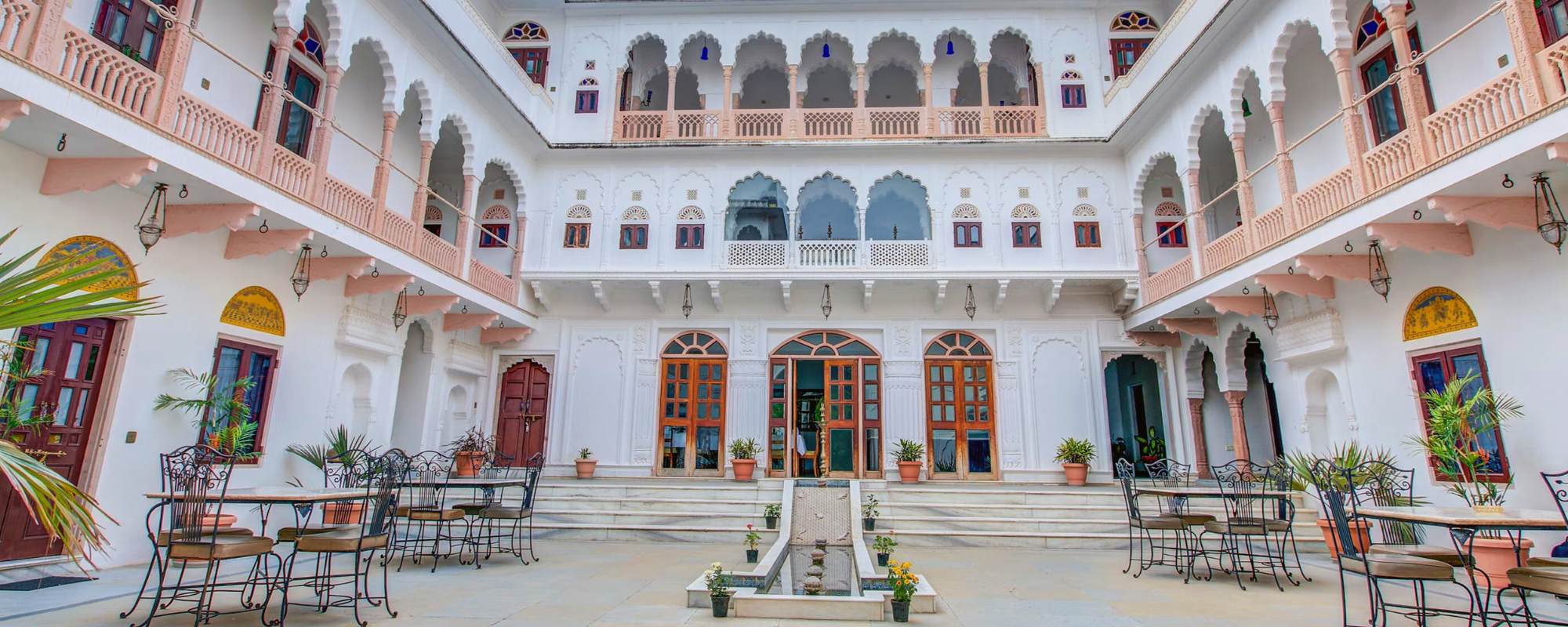



Located 150 km from Jaipur, between Agra and Ranthambore National Park in Rajasthan, Ramathra was granted as a Jaagir (fiefdom) in 1645 CE to Thakur Bhoj Pal by his father, the Maharaja of Karauli. Ramathra Fort is a 350-year-old fort, beautifully perched on a hillock, which offers fantastic views over the countryside around it and offers guests a superbly unique, boutique, rural experience. This stunning hill fort is part of a green farming belt in the Kalisil River valley and is set between Keoladeo National Park in Bharatpur and Ranthambhore National Park in Sawai Madhopur.

Today, Ramathra Fort belongs to Thakur Brijendra Raj Pal and his family, who are descendants of the founder. The fort has a strong perimeter wall crowned with parapets. Its ramparts are wide and offer a spectacular view from the hilltop. Inside, there is a multi-story palace, parts of which are being restored using traditional building techniques and local craftspeople. Stone lattices and a painted ceiling ornament are otherwise simple features. After all, it was designed as a battle fort.


Explorations & Experiences in Ramathra-

Places to visit in Ramathra:

  • Ramathra Fort
  • Ramathra Village
  • Kalisil Dam
  • Kaila Devi Sanctuary
  • Karauli


Things to do in Ramathra:

  • Stay at Ramathra Fort Heritage Hotel
  • Ramathra Village walk tour
  • Boating at Kalisil Dam
  • Bird Watching
  • Wildlife tour at Kaila Devi Sanctuary
Reach out to our Local Experts
Plan Your Bespoke Journey with Us

Fill in your details and one of our destination experts will get in touch with you. Our experts are dedicated to providing personalized assistance and insights, ensuring that all your queries are addressed and you receive the best possible guidance for your travel plans.


Checkout our
Latest Blogs
Choose from the best
Hotel Partners
Get our latest updates
Subscribe Our Newsletter

Stay Connected
FAQs
  • Who is Ramathra Fort really suited to?

    This 17th-century battle fort in the Karauli district, roughly 160 km southeast of Jaipur near the village of Sapotra, sits above the Kalisil Lake with views across ravines, scrubland, and farmland toward the Chambal valley. Still owned by descendants of the founding family and accommodating just 12 guests across six suites and six tents, it suits couples seeking a peaceful rural escape, wildlife and birding enthusiasts, and anyone wanting genuine disconnection from urban India, more than travellers looking for resort amenities.

  • What is the Ramathra Fort's history?

    Granted as a jagir in 1645 AD by the Maharaja of Karauli to Thakur Bhoj Pal, the fort's name honours Lord Rama, who, according to local tradition, camped here during his journey to Lanka. Built for defence, its wide ramparts and hilltop position reflect a focus on both strategy and visibility. Thakur Brijendra Raj Pal, a direct descendant of the founder, owns and runs it today with his family, continuing to restore parts of the palace using traditional techniques rather than modernising it into a polished hotel product.

  • What is the appeal of the Kalisil Lake here?

    It is a genuinely wild lake rather than a managed resort feature, with mugger crocodiles basking on its banks and painted storks, kingfishers, herons, Sarus cranes, and cormorants gathering year-round, joined by migratory waterfowl in winter. Dawn boat rides are the standout experience: crocodiles surfacing in the early light, birds at their most active, and mist over the surrounding hills combine for a rare stillness. Guests can also use a rowing boat on their own.

  • What wildlife is there beyond the lake?

    The surrounding Daang region, part of the wider Ranthambore ecosystem, supports nilgai, chinkara, sambar deer, wolves, striped hyenas, jackals, and foxes, with leopards and sloth bears present but less reliably seen. Kaila Devi National Park, which connects to Ranthambore, begins just 15 km away and is the primary safari zone. Night safaris across the Daang plateau regularly turn up deer and nilgai, occasionally wolves and hyenas, and the Chambal River valley within an hour's drive is globally significant for the critically endangered gharial and the Indian skimmer.

  • What is there to do beyond the lake and the wildlife drives?

    Village walks through Ramathra introduce farming and herding families, with visits to the Ganesh and Shiva temples. Jeep safaris cross the Daang plateau toward the Chambal, passing Utgir Fort and the cave temples of Ghanteshwar and Kurka. Cycling routes through the valley allow self-guided exploration, and a hot tub on one of the fort's turrets, positioned for sunset, is an unexpectedly memorable feature.

  • What kind of accommodation does Ramathra offer?

    Just 12 guests in total: six suites within the fort and six luxury tents in a courtyard beneath the ramparts. The two largest suites each have a private terrace overlooking the lake, a fireplace, and an outdoor bathtub with hill views; four deluxe suites open onto the courtyard and are slightly smaller but equally well appointed. The tents sit on lawns with hand-woven rugs and outdoor showers. Meals are prepared from the fort's own farm produce and often shared with the family when they are in residence.

  • How many nights make sense at Ramathra?

    Two to three. A single night includes a sunset boat ride, a village walk, and a jeep safari, but two nights add a dawn lake ride, a longer plateau excursion toward the Chambal, and the unhurried pace that defines the property. A third night suits those adding a full-day Ranthambore tiger safari, 80 km away. Birding, the changing light on the ramparts, and evening conversation with the family reward taking time.

  • When is the best time to visit Ramathra?

    October to March, when temperatures are comfortable and the lake's birdlife peaks from November to February, with dawn boat rides in December and January especially memorable in the mist. The monsoon, July to September, brings green countryside, but the approach roads, rough even in the dry season, become genuinely difficult in heavy rain. April and May reach 40 to 42 degrees Celsius, manageable in the fort itself but harder for midday outdoor activity.

  • How remote is Ramathra in practice, and how do I get there?

    Genuinely remote. It is roughly 160 km southeast of Jaipur, a four-hour drive through increasingly rural countryside, with a high-clearance vehicle advisable for the final approach roads. The nearest railway station is Gangapur City, 40 km away. From Agra, it is 225 km, about three and a half hours. The remoteness is the point rather than an inconvenience: the absence of traffic and noise gives Ramathra its stillness.

  • How does Ramathra work within a wider Rajasthan or India itinerary?

    Its position between three major destinations is its strongest card. Ranthambore, 80 km southwest, is the natural wildlife pairing; Bharatpur's Keoladeo National Park, roughly 120 km north, adds a UNESCO bird sanctuary; and Agra, 225 km away, allows Ramathra to extend a Golden Triangle trip with genuine rural depth. For a full Rajasthan circuit, it works as the authentic eastern counterpoint to the more visited western destinations.

Plan Your Trip